Clearing the Way: What the Strait of Hormuz Mine Operation Means for Maritime Workers
The U.S. Navy is sweeping Iran’s mines from the world’s most critical energy chokepoint. Here’s why the technology, the timeline, and the risks matter — and what workers in harm’s way need to know.
If you work on the water, whether crewing a tanker through the Gulf of Oman, running cargo to a platform in the Persian Gulf, or manning a container ship just trying to get to its destination— you have a very direct stake in what is happening right now in the Strait of Hormuz. Last weekend, the U.S. military announced it had begun active mine-clearance operations in that narrow passage, sending in naval vessels and promising additional forces, including underwater drones, in the days ahead. For maritime workers anywhere in that theater, and for the families watching from home, the next several weeks will be consequential.
Iran deployed roughly a dozen mines in the Strait of Hormuz following U.S. and Israeli strikes in late February — cheap, passive weapons with the powerful ability to shut down the world’s most important oil chokepoint. President Trump has stated that all Iranian minelaying ships have been sunk; whether additional devices remain is a question the Navy needs to answer.
The Nature of the Threat
Maritime mines are some of the oldest weapons in the naval arsenal, and they remain devastatingly effective because of their simplicity. Iran is believed to have utilized several distinct types:
- Bottom mines that rest on the seabed waiting for a ship’s magnetic or pressure signature to trigger them;
- Tethered mines anchored just below the surface;
- Drifting mines that move with the current;
- Limpet mines designed to be attached directly to a ship’s hull.
Each type presents a different detection challenge and requires a different removal strategy, and none of them care what flag your vessel flies, or whether your papers are in order.
The economic consequences are obvious. The Strait of Hormuz is the transit point for roughly 20% of the world’s oil supply. Since February, the disruption to shipping has “severely curbed global energy supplies,” as Reuters reported — a fact felt at every fuel pump and in every logistics budget. For seafarers working those routes, the disruption also means rerouted voyages, delayed port calls, and the kind of ambient danger that never fully leaves you when you know the water beneath your hull may not be empty.
How Minesweeping Actually Works
The Navy’s minesweeping techniques have evolved from the days of manned ships dragging mechanical gear through active minefields — a method that was effective but put crewmen in direct danger. The newer approach relies on stand-off technology: unmanned surface and underwater vehicles equipped with sonar scan suspected areas, which transmit data back to operators safely outside the minefield, and then guide remotely operated neutralization devices onto confirmed targets. The torpedo-shaped Archerfish, for example, is a cable-guided robot roughly two meters long that carries its own explosive charge and destroys a mine on contact, without putting any crew at risk.
Helicopters also play a role, spotting mines that float near the surface, and human divers may be deployed for intelligence gathering, or in situations where robotic systems are less effective.
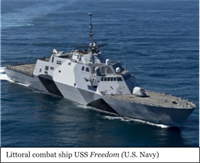
The Navy currently has four traditional Avenger-class minesweeping vessels, unmanned undersea vehicles, and helicopters in the Middle East theater. Three light littoral combat vessels, carrying the latest robotic mine-hunting technology, have been deployed as well, with two more on the way after completing maintenance.
The multi-step nature of the process — detection, data analysis, identification, neutralization — is also time-consuming, and can leave sweeping crews vulnerable. If mine-clearance operations ever encountered any aggressors, the Navy would need to deploy defensive assets to protect the ships it sent in to make the water safe.
The Timeline — and What It Means
Experts estimate the clearance operation could take two to three weeks, assuming no significant interference. That assumes known mine locations, cooperative conditions, and no new mine deployments, which can’t be guaranteed. Advanced precision in mine countermeasure (MCM) sonar technology and AI-assisted data analysis aboard unmanned vessels should speed progress. But the fundamental bottleneck remains human: someone must look at the data, confirm the target, and authorize the shot.
For shipping companies and their crews, the practical question is when the strait will be reliably passable again. The answer remains genuinely uncertain. Although the strait has reportedly been “opened for commercial transit” as of Friday for the duration of a 10-day ceasefire between Israel and Lebanon, this may be temporary if the mines, as well as the U.S. Naval blockade, remain. Insurers, operators, and flag states are watching the operation closely.
The Legal Dimension for Maritime Workers
When a vessel passes through a war zone, or is ordered to do so by an operator, the legal and contractual landscape changes. Seamen injured in or near active mine-clearance operations, or as a result of mine detonations or combat-related incidents, may have rights and claims that look very different from the ordinary Jones Act or maintenance-and-cure framework. War risk provisions in employment contracts and collective bargaining agreements matter. So does the question of whether an employer adequately warned crew of a known danger, or whether crew members were ordered into harm’s way without sufficient information or protection.
Watching the Water
Eventually, naval engineers will ideally deploy autonomous swarms of unmanned drones that can search, identify, and destroy mines in a single integrated operation. That capability “doesn’t exist today”, states Mark Bock, retired U.S. Navy captain and VP of business development at French defense technology group Thales’ U.S. Navy business, “but it is what all nations are trying to achieve now.”
In the meantime, crews doing this work in the Strait of Hormuz must keep ships safe by doing it the traditional way: carefully, slowly, and not without risk.
We at the Herd Law Firm are proud to fight for seamen, maritime workers and passengers in all types of personal injury and death claims. As maritime personal injury attorneys (and sailors ourselves!) located in northwest Houston, we never waver in our commitment to help these maritime workers, passengers, and their families when they are injured or mistreated.
Herd Law Firm, LLC.
-
Charles Herd Lead Attorney
- April 27, 2026
- (713) 955-3699
- Send Email
